
Late Romantic soundscapes
Ethel Smyth’s ‘Mass in D’ will be performed by students at the Herderkirche
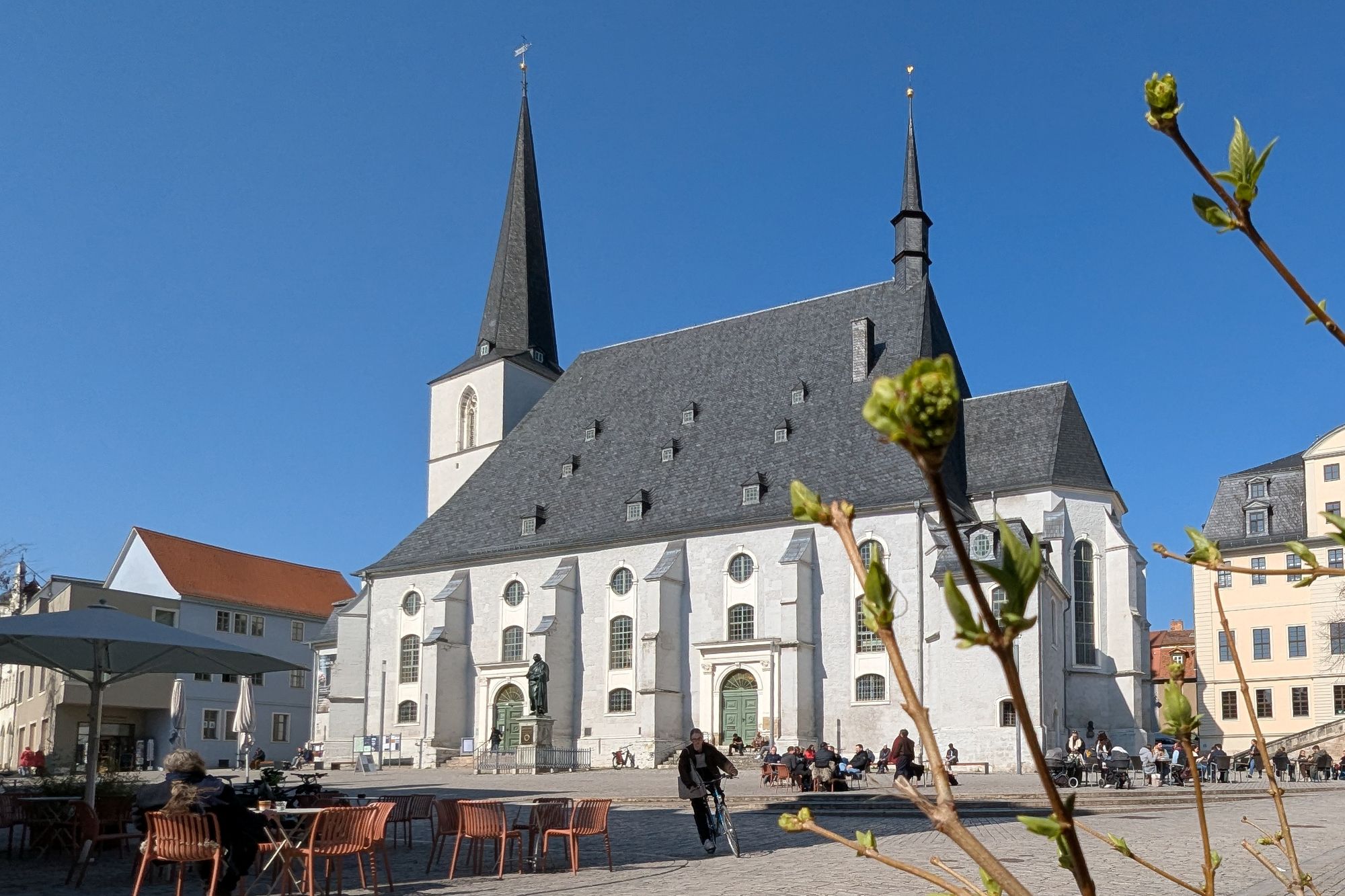
A mass that breaks away from the standard repertoire: Church music students Annabelle Sachse and Felix Schramm will perform the rarely heard work “Mass in D” by Ethel Smyth at St Peter and Paul’s Church (Herderkirche). The concert on Saturday 18 April at 7.30 pm marks the culmination of their diploma studies in choral and orchestral conducting for both students. The students from Prof. Martin Sturm’s class will present a work that is both musically challenging and culturally and historically significant.
“The Mass moves through late Romantic soundscapes with great dynamic contrasts and a richly coloured orchestration,” says Annabelle Sachse, describing the work. The large ensemble is particularly striking. Around 100 students, alumni and young musicians will take part in the performance in Weimar, featuring in the choir, orchestra and solo parts. The soloists for the evening are Mirijam Denz (soprano), Nolwenn Tilly (alto) and Samuel Huhn (bass). Admission is free.
Unlike many mass compositions, Smyth’s work was not composed for liturgical use, but explicitly for the concert hall. Smyth also deviates from the traditional mass order in terms of structure: the Gloria stands as the musical climax at the end of the work and not – as is customary in liturgy – after the Kyrie.
Ethel Smyth is one of the most important female composers of the 19th century. For a long time, her music remained in the shadow of her male contemporaries. Through her involvement in the English women’s movement and her open, queer lifestyle, she took a courageous step even back then that continues to inspire us today.
With their project, the students aim to contribute to the visibility of female composers in concert life. Furthermore, Felix Schramm emphasises that their work stands for diversity, student initiative and an equal, open and democratic coexistence: “Especially in a time of increasing social tensions, we see music as an opportunity to bring people together”. Students from different degree programmes and various countries are working on the project and can thus “create encounters and connections through music”.
The artistic responsibility lies equally with the two organisers. The selection of the choir, orchestra and soloists, as well as the planning of rehearsals and the choice of instruments, are also entirely in the hands of the students. In doing so, they gain important practical experience for their future careers.
[19 March 2026]