
Underestimated art
The "KlangZeiten - Music, Politics and Society" book series celebrates its 20th anniversary
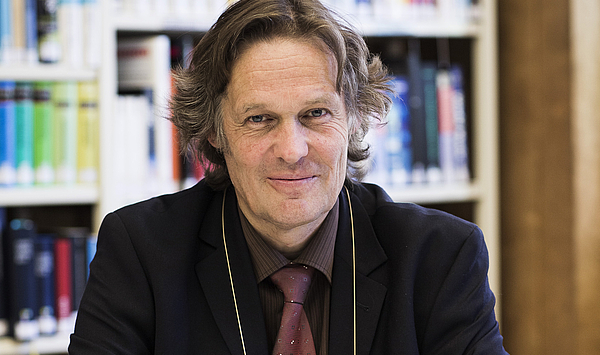
The book series "KlangZeiten - Musik, Politik und Gesellschaft" celebrates its 20th anniversary in 2024. The musicological series, which has been published since 2004, was conceived and founded by Prof Dr Albrecht von Massow, who teaches at the Joint Department of Musicology of the University of Music FRANZ LISZT Weimar and the Friedrich Schiller University Jena.
Co-editors for many years were Prof Dr Detlef Altenburg, Prof Dr Michael Berg and Prof Dr Helen Geyer. The series has been published by Böhlau-Verlag (Cologne, Weimar, Vienna) from the outset. Important impulses initially came from research into the history of music in the GDR, which has been carried out in Weimar since 1989, especially by Michael Berg, who was able to draw on extensive experience from the GDR era.
The first volume, "Between Power and Freedom - New Music in the GDR", resulted from the symposium "Music Power Perspectives", which was organised in 2001 and developed by Professors Berg and von Massow in collaboration with students from the Weimar University of Music. Other volumes dealt with "Musical Deconstruction - New Instrumental Music in the GDR" and "Musicology and the Cold War - The Example of the GDR".
"Nevertheless, the potential topics of the series were designed to be both historical and intercultural from the outset," says the initiator of the series, Prof Dr Albrecht von Massow. "This has allowed the range of topics to be gradually broadened and will hopefully continue to expand in the future."
"KlangZeiten" showcases both external book projects and internal book projects from Faculty III of the University of Music FRANZ LISZT Weimar. Internal book projects include not only some from the Department of Musicology Weimar-Jena, but also some from the Department of School Music and Church Music.
Several volumes of "KlangZeiten" were accompanied by CDs with rare or difficult to access music. "The conception and realisation of the publication series - based on Weimar - reflects the awareness that although Central Germany is politically marginal, it is culturally of great importance," explains Prof. Albrecht von Massow.
"Central Germany is the easternmost tip of the North Atlantic cultural area. Especially in times when the East-West conflict has flared up again, this awareness offers potential that lies beyond the interpretative sovereignty of politics and the media and also contributes to the development of the profile of Central German music and music education."
Previously published volumes in the "KlangZeiten" series:
Zwischen Macht und Freiheit – Neue Musik in der DDR, hg. von Michael Berg, Albrecht v. Massow u. Nina Noeske, Köln, Weimar, Wien 2004, 198 Seiten mit 2 CDs.
Die unerträgliche Leichtigkeit der Kunst – Ästhetisches und politisches Handeln in der DDR, Köln, Weimar, Wien 2007, 205 Seiten.
Nina Noeske, Musikalische Dekonstruktion – Neue Instrumentalmusik in der DDR, Köln, Weimar, Wien 2007, 434 Seiten mit 2 CDs.
Matthias Nöther, Als Bürger leben, als Halbgott sprechen – Melodram, Deklamation und Sprechgesang im wilhelminischen Reich, Köln, Weimar, Wien 2008, 328 Seiten mit 1 CD.
Ruth Seehaber, Die „polnische Schule“ in der Neuen Musik – Befragung eines musikhistorischen Topos, Köln, Weimar, Wien 2009, 346 Seiten.
Matthias Tischer, Komponieren für und wider den Staat – Paul Dessau in der DDR, Köln, Weimar, Wien 2009, 344 Seiten.
Musikwissenschaft und Kalter Krieg – Das Beispiel DDR, hg. von Nina Noeske u. Matthias Tischer, Köln, Weimar, Wien 2010, 195 Seiten.
Die Kunst des Überwinterns – Musik und Literatur um 1968, hg. von Jörn Peter Hiekel, Köln, Weimar, Wien 2011, 142 Seiten.
Irmgard Jungmann, Kalter Krieg in der Musik – Eine Geschichte deutsch-deutscher Musikideologien, Köln, Weimar, Wien 2011, 182 Seiten.
Katrin Stöck, Musiktheater in der DDR – Szenische Kammermusik und Kammeroper der 1970er und 1980er Jahre, Köln, Weimar, Wien 2013, 314 Seiten.
Marco Lemme, Die Ausbildung von Kirchenmusikern in Thüringen 1872-1990, Köln, Weimar, Wien 2013, 555 Seiten.
Melanie Kleinschmidt, „Der hebräische Kunstgeschmack“ – Lüge und Wahrhaftigkeit in der deutsch-jüdischen Musikkultur, Köln, Weimar, Wien 2015, 268 Seiten.
Ein Prisma ostdeutscher Musik – Der Komponist Lothar Voigtländer, hg. von Albrecht v. Massow, Thomas Grysko u. Josephine Prkno, Köln, Weimar, Wien 2015, 125 Seiten mit 2 CDs.
Ruth Berghaus und Paul Dessau: Komponieren – Choreographieren – Inszenieren, hg. von Nina Noeske u. Matthias Tischer, Wien, Köln, Weimar 2018, 128 Seiten mit 34 Abbildungen und Notenbeispielen.
Albrecht v. Massow, Die unterschätzte Kunst – Musik seit der Ersten Aufklärung, Wien, Köln, Weimar 2019, 455 Seiten mit 55 Notenbeispielen.
Verfolgte Musiker im nationalsozialistischen Thüringen – Eine Spurensuche, hg. von Helen Geyer u. Maria Stolarzewicz, Wien, Köln, Weimar 2020, 347 Seiten.
Marianne Nowak, Polnische Komponisten bei den Internationalen Ferienkursen für Neue Musik Darmstadt um 1960, Wien, Köln, Weimar 2020, 347 Seiten.
Harriet Oelers, Elektroakustische Musik in der DDR – Rezeption, Institutionen und Werke, Wien, Köln 2021, 330 Seiten.
Musik und Liebe, hg. von Nina Noeske u. Matthias Tischer, Wien, Köln 2022, 131 Seiten.
Verfolgte Musiker im nationalsozialistischen Thüringen – Eine Spurensuche II, hg. von Maria Stolarzewicz, Wien, Köln 2023, 291 Seiten.
Kurz vor Drucklegung:
Albrecht v. Massow, Das Wissen der unterschätzten Kunst, ca. 460 Seiten.
[19 January 2024]