
Melos and ostinato
Works by composition student Aaron Dan could be heard at the Goethe Medal award ceremony in Weimar
The most important award in Germany's foreign cultural policy was recently presented in Weimar: The Goethe Medal 2024 went to three women - the literary translator and interpreter Claudia Cabrera from Mexico, the arts scholar and cultural manager Iskra Geshoska from North Macedonia and Carmen Romero Quero, the founder and director of the Chilean theatre festival ‘Teatro a Mil’.
Part of the ceremony at the award ceremony is that the music played is not just a mere backdrop, but takes on a narrative strand of its own. The music reflects the origins and, above all, the work of the award winners. The idea was born back in 2012 in an exchange between the then President of the Goethe-Institut, Prof Klaus-Dieter Lehmann, and the Weimar Professor of Transcultural Music Studies, Prof Tiago de Oliveira Pinto.
Now in its 13th edition, the music programme curated by Prof. Pinto has established itself as a separate and integral part of the ceremony. In all these years, both students and teaching staff have been able to contribute to a dialogue with the work and significance of the award winners. There is now always a world premiere of a work composed especially for the Goethe Medal.
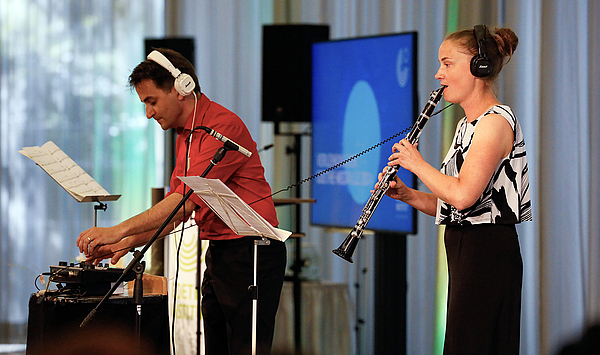
This year, two compositions by Aaron Dan, a composition student in Prof Jörn Arnecke's class in Weimar, were performed. He created the works MELOS for flute and electronics (world premiere) and OSTINATO for clarinet and loop station (premiere of the original version), which related to the overall theme of ‘Translations, art and science, counterpoints in encounters’. The performers were the composer himself (flute and loop station) and clarinettist Friederike Roth.
Commenting on his work MELOS , Aaron Dan said: ‘I would like to give a thought-provoking impulse here, according to which the gods did not give mankind music, but intervals. Every artist creates music in his own way from his knowledge, his culture and his spiritual inspiration using the intervals. These in turn are timeless, eternally valid proportions, as we encounter them in the microcosm and macrocosm at all times and incessantly.’
[3 September 2024]