
Modes of Musical Existence
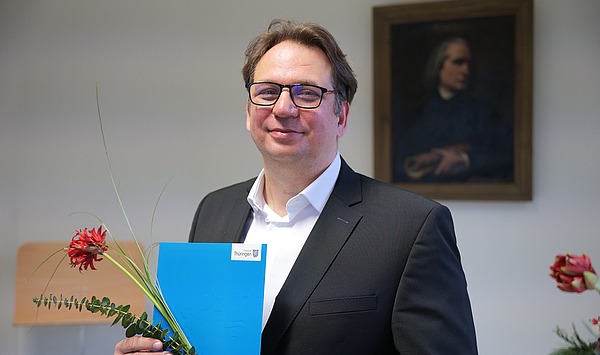
Inaugural Lecture by Matthias Lewy, Professor of Transcultural Music Studies
Prof. Dr. Matthias Lewy’s inaugural lecture consists half of music and half of reflections on it. In doing so, the musicologist casts his gaze far beyond European borders. “Modes of Musical Existence—Collaborative Research and Teaching in Transcultural Music Studies” is the title of the public lecture, which will take place as part of the university’s 154th anniversary celebration, the “Dies Academicus,” on Wednesday, June 24, at 6:00 p.m. in the Festsaal Fürstenhaus. Admission is free.
The evening will open with rhythms from Iran played on the daf frame drum, followed by sounds from the Zagros Mountains on the ney shepherd’s flute and a “Chūpāni” improvisation. To conclude, the artist E. Zare will present a festive and mystical dance repertoire as well as a folk lullaby, performed in part on the balaban wind instrument. Following this, Prof. Dr. Matthias Lewy, who teaches at the Department of Musicology Weimar-Jena, will deliver his inaugural lecture.
Another highlight of the evening will be the handover of the co-chair of the Weimar “UNESCO Chair on Transcultural Music Studies” by the current chair, Prof. Dr. Tiago de Oliveira Pinto. The official handover of the chair is scheduled for 2027.
To round off the evening, the “Transcultural Choro Ensemble” will perform under the direction of Tiago Santos. Choro is a Brazilian artistic and cultural practice, a musical genre whose earliest traces date back to the mid-19th century. In 2024, choro was recognized as part of Brazil’s intangible cultural heritage. The ensemble consists of students participating in the artistic-scholarly project seminars of the “UNESCO Chair on Transcultural Music Studies,” as well as alumni of the Weimar Music university. They will perform ten different choro pieces on instruments including the mandolin, clarinet, saxophone, accordion, violin, guitar, and cavaquinho.
Prof. Dr. Matthias Lewy, born in Magdeburg in 1973, studied Comparative Musicology as well as Cultural and Social Anthropology at the Free University of Berlin and additionally earned a diploma in Cultural and Media Management from the “Hanns Eisler” University of Music in Berlin. After early career experiences in cultural and music management—including stints at Piranha Musik and the world music network WOMEX—he turned to academia. Beginning in 2005, he conducted extensive field research in Venezuela and northern Brazil, which formed the basis for his doctoral dissertation and his subsequent work on the sound ontologies of the Amazon.
From 2015 to 2019, he was a professor of ethnomusicology at the University of Brasília. He then moved to Switzerland, where he served as a professor of research and teaching at the Competence Center for Music Education Research at the Lucerne University of Applied Sciences and Arts until 2024. In 2024, he completed his habilitation at the Franz Liszt University of Music in Weimar and received the venia legendi in musicology.
His research encompasses sound ontologies of the Amazon, popular music of Latin America and the Caribbean, as well as issues of collaborative archiving and curatorial museum practice, currently within the Collaborative Research Center project “Resozialisierung von Klang / Resocializing of Sound.” He is a member of the Federal Expert Committee on Cultural Diversity of the German Music Council.
[19 June 2026]