Resocialization of Sound: Collaboration in Research, Archiving and Dissemination with Amazonian Collectives
NEWSLETTER
#2 Activity Report: February – March 2026
Dear colleagues and partners,
This second activity report covers February and March 2026, a period marked by active research, new archival discoveries, and some important adjustments to our project timeline.
Research in Progress
Bruno Britto — MEG Geneva Collection
Bruno Britto continues his work on the MEG Geneva Wayana collection, developing an ethnographically grounded reorganization based on the existing bibliography on the Wayana and Aparai peoples. Starting from the museum’s catalog structure — with its system of reference numbers, recordings, and descriptive units — he is building an alternative organizational framework that connects archival materials to musical, ritual, and instrumental contexts documented in the ethnographic literature.
Every step in this reorganization involves interpretive decisions, and Bruno is carefully documenting his criteria and reasoning. This methodological work will be central to his master’s thesis, for which a first structural outline is expected by April 2026.
Thiago da Costa Oliveira — Museu Nacional Kuikuro Video Archive Over the past weeks, I have been working intensively with approximately ten hours of archival video footage from the early phase of the Video nas Aldeias project, which documented a Kuikuro ritual some twenty years ago. In collaboration with Indigenous specialists who are translating and commenting on the material in Portuguese, I am examining the relationship between the process of mask-making, the music of the Kuikuro sacred flutes, and the broader dynamics of collective ritual action. What emerges from this material is a striking picture of the entanglement between sound, body, object, and social organization: the mask is not an isolated artifact, but the focal point of a synesthetic and collective process in which music structures action at every stage. This analysis is being developed toward a co-authored article with Carlos Fausto, professor of the National Museum of Rio de Janeiro and specialist in the Kuikuro people, with a first draft targeted for June 2026.
Matthias Lewy and Natasha Gordon — Pemón Collection
Prof. Matthias Lewy is currently working with Natasha Gordon to systematically organize his personal research archives on the Pemón people, encompassing videotapes, audio tapes, photographs, fieldnotes, and other media accumulated over years of fieldwork. This foundational organizational work feeds directly into the development of the Pemón database subproject, which will eventually form part of our project database.
Video Release: Edilson Curuaia’s Visit to Berlin
As promised in our previous newsletter, we are pleased to share the video documentation of Edilson Curuaia’s January 2026 visit to the Ethnological Museum Berlin.
UNIFAP Course Update and Evolving Calendar
The in-person phase of Module I of the course “Training in Cultural Heritage and Collaborative Research with the Wayana and Aparai Peoples,” developed in partnership with the Federal University of Amapá (UniFAP) and APIWA under a UNESCO framework, has been rescheduled. Originally planned for July 2026, the in-person phase will now take place from January to March 2027, following a decision taken by the PARFOR Equidade students themselves. The calendar remains subject to changes, so this is an evolving matter.
The workshop with Wayana-Aparai knowledge holders in Indigenous territory was also discussed in our March 10 meeting with APIWA representatives Arinaware Aparai and Kutanan Wayana, and with Iepé representatives (Pedro Bezerra Ribas and Sofia Galvão). It is now planned for April 2027, following the in-person course phases.
Focus for 2026: Research, Database, and Geneva Visit With the course now scheduled for 2027, the project’s main activities for 2026 are organized around three interlocking priorities:
• Ongoing archival research, as described in the previous section, is running in parallel with Bruno Britto’s fieldwork trip, provisionally planned for July 2026. This visit will focus on collaborative work on the database and the translation and contextualization of archival materials together with locally appointed focal points.
• Database development: completion of the project database in Portuguese by mid-2026, integrating the MEG Schöpf Collection materials — more than 5,000 photographs, sound recordings, approximately 300 artefacts from the 1970s, and Rauschert/TMS materials. The project team is working toward appointing two local collaborators in Macapá, Wayana-Aparaia, nominated by APIWA.
• Visit to MEG Geneva (October 2026): a group of 5–6 Wayana-Aparai specialists in music, instruments, and traditional rituals is scheduled to visit the MEG Geneva collections in October 2026. The visit will be an important moment of direct engagement between the community knowledge holders and the historical archival materials.
Exhibition Planning — “The Life of Sound Archives”
This period, Madeleine Leclair and I completed a first draft of a preliminary exhibition concept note for a proposed 2028 MEG exhibition — a required step in the museum’s internal approval process. The note presents the exhibition’s core concept: the social life of sound archives from a Wayana-Aparai perspective, and what it means for a European ethnographic museum to take that perspective seriously in its archival and curatorial practices. Planned formats include multisensory installations, listening stations, immersive sound diffusion, an archive library, and contemporary artistic interventions in dialogue with the historical collections. If approved, the exhibition is set to open at MEG Geneva in June 2028.
Main project goals completed during the last two months • Database contract and implementation • Memorandum of Understanding between the Chair of Transcultural Music Studies at the Department of Musicology, Franz Liszt University of Music Weimar, and the Federal University of Amapá, Indigenous Intercultural Bachelor's Degree Course – PARFOR Equity, coordinated by Prof. Dr. Agerdânio Andrade de Souza.
• Delivery of the Rauscher/Pinto tapes for digitization.
• First draft of the preliminary exhibition concept note for the proposed MEG exhibition, co-developed with Madeleine Leclair.
Upcoming priorities
• Appoint and onboard Macapá-based local collaborators (target: May–June 2026) • Receive APIWA nominations for Geneva visit specialists and focal points (deadline: beginning of April) • Bruno Britto: thesis structure — first outline by April 2026 • First version of the project database, including an approved data scheme, the import of the entire MEG collection, and fields for translation of data from French to Portuguese (for May 2026).
• First draft of Kuikuro ritual article (Thiago da Costa Oliveira and Carlos Fausto) — target: June 2026 • Prepare logistics for MEG Geneva visit (for October 2026)
Resocialization of Sound is funded by the Swiss National Science Foundation (Grant #220198) and led by Hochschule für Musik Franz Liszt Weimar in collaboration with MEG Geneva.
I am Thiago da Costa Oliveira, the project coordinator.
We look forward to sharing further updates soon!
#1 Activity Report: September 2025 - January 2026
Dear colleagues and partners,
This newsletter represents our first attempt to establish a regular communication channel with all project stakeholders. Going forward, we will send these updates monthly to keep you informed about the project's development, key decisions, and upcoming activities as we work together toward the resocialization of archival materials with Amazonian Indigenous communities.
Strategic Refocus
Following extensive consultations with our partners, we have decided to concentrate the project's efforts on exemplary, in-depth work with the Wayana-Aparai peoples. This strategic focus allows us to develop comprehensive methodologies and collaborative protocols that can serve as models for similar work. This refocus does not prevent us from working strategically with other project partners and from continuing to digitize the HfM Weimar Kayapo/Xikrin collection. We continue our collaboration with Curuaia researchers, as detailed below, and have activated a new Pemón subproject, with Natasha Gordon contracted as a specialist to work on the Pemón collection held at HfM Weimar.
MEG Geneva Collection and Database Development
In December, I visited the MEG Geneva (December 15-17) for meetings with the curatorial team, including consultation on the planned 2028 exhibition "Life of Archives." These discussions reinforced the strategic decision to focus our work on the Wayana-Aparai component, as the exhibition will center on demonstrating the life cycle of archival materials from its collection/creation to concrete examples of resocialization that allow us to discover new sonic worlds.
In January, thanks to the efforts of Madeleine Leclair and Grégoire de Ceuninck, MEG completed the transfer of the Schöpf Collection data: 663 Wayana objects, 26 sound recordings, and 5,088 photographs. This material is now being prepared for integration into Tainacan, the Brazilian-developed database platform we will use for collaborative archival access. We received a new proposal for Tainacan development on January 30, with implementation planned for March through May 2026. The platform will eventually host collections from MEG and HfM Weimar (Wayana-Aparai, Xikrin, and Pemón materials).
Curuaia Collection Consultation
In January (20-26), Edilson Curuaia visited Berlin to consult the Curuaia materials held at the American collection of the Ethnological Museum, curated by Stephanie Schien. The visit benefited from Diana Zschuppe's administrative support and Bruno Britto's careful accompaniment throughout Edilson’s trip.
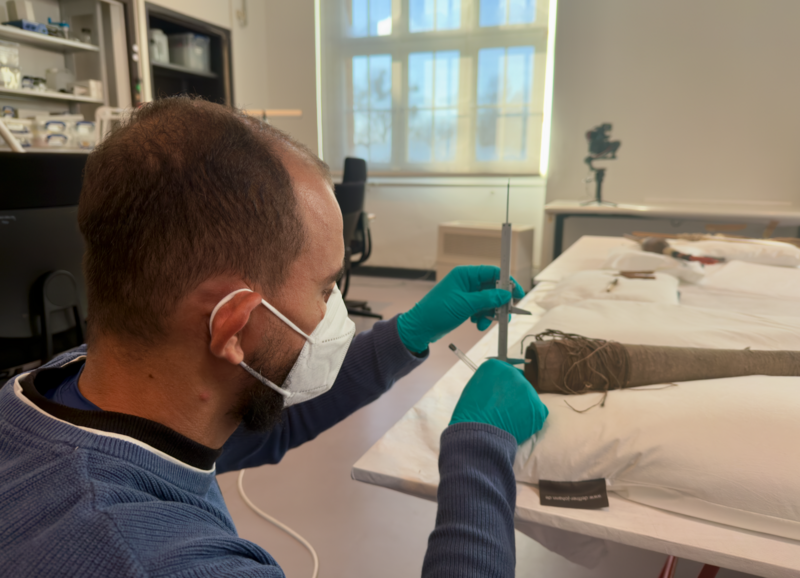
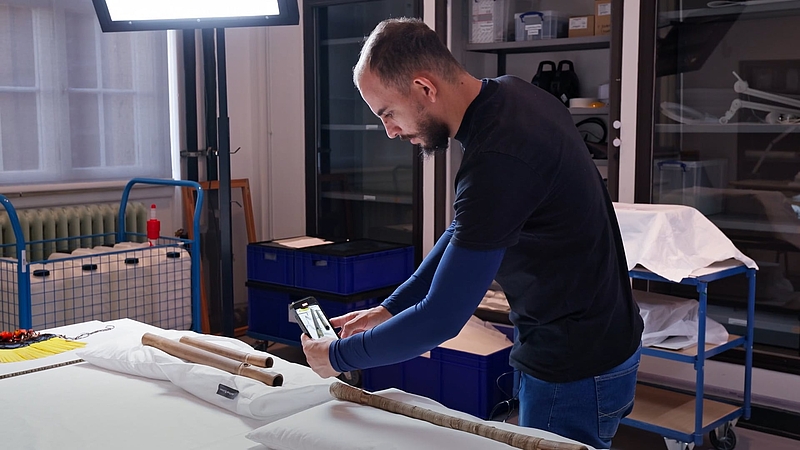
During his visit to the museum's technical reserve, Edilson studied 15 pieces, including a trumpet that will inform his re-elaboration of traditional Curuaia musical instruments.
Edilson also visited the Ibero American Institute to locate a specialized bibliography on the Curuaia people and was welcomed by its director, Barbara Göbel. He then participated in a workshop at HfM Weimar on January 24, where he presented his research findings and cultural experience, and we began planning the next stages of this work. A detailed visit report from Bruno Britto is expected by the end of this month, along with my editing of the video documentation.
UniFAP Course Development
We have been developing the structure for "Training in Cultural Heritage and Collaborative Research with the Wayana and Aparai Peoples" in partnership with the Federal University of Amapá. The partnership with UniFAP and APIWA aims to establish institutional channels for the resocialization of collections and archives. The course will consist of two modules running from April 2026 through June 2027. Each module includes 20 hours of in-person instruction followed by 20 hours of activities in Indigenous villages.
Working with APIWA (Aparai-Wayana Indigenous Peoples Association) and UniFAP, we have identified eight cultural specialists in Wayana-Aparai music for participation. The course will involve two language monitors, one technical monitor, one APIWA administrator, and three UniFAP professors.
On January 28, we met with IEPÉ (the NGO that advises APIWA) to discuss concerns about the course structure, particularly regarding payment models and the logistics of the village-based component. A meeting with all actors is scheduled for February 4 to address these questions and finalize the course design. The MoU for the course is currently being revised internally at HfM Weimar.
Additional Collections Work
We are also moving forward on the digitization of the Rauschert/Oliveira Pinto Collection held at HfM Weimar. A meeting with the Thuringian State Music Archive is scheduled for February 10 to discuss in-house options and next steps.
Upcoming Priorities
In February, our immediate priorities include finalizing the UniFAP course structure with all partners, contracting the Tainacan developer, beginning work on Module I content elaboration with Prof. Tiago de Oliveira Pinto, and continuing the digitization discussions. We will also organize the Nextcloud folder structure and update the MEG project website. The project team has established bi-weekly coordination meetings and updated both the HfM Weimar and SNSF websites. We will continue to work closely with our partners at APIWA, IEPÉ, UniFAP, MEG Geneva, and the Ethnological Museum Berlin as the project moves forward.
Resocialization of Sound is funded by the Swiss National Science Foundation (Grant #220198) and led by Hochschule für Musik Franz Liszt Weimar in collaboration with MEG Geneva. I am Thiago da Costa Oliveira, the project coordinator.